Bridging Enterprise Scale
& Builder Mindset
Senior Product Professional and Independent AI Consultant. I've found that the most impactful product work happens when you don't just plan—you build. I combine senior-level product craftsmanship with a builder's mindset by using AI to unlock velocity...moving from discovery to delivery faster than ever.



Case Studies
From enterprise compliance platforms to digital transformations, here is how I have driven impact at scale.
How This Shaped Me
Operating in highly matrixed, compliance-heavy environments taught me three things: (1) planning and coordinating changes early—especially with compliance teams—paid off because I found that building guardrails into the process was faster than bolting them on later, (2) I saw different stakeholder groups actually align on what's best for the organization when I gave them transparent prioritization frameworks and someone to bring them together, and (3) I learned that proper facilitation through complex multi-stakeholder decisions is just as important as understanding your customer or having strong product vision. For me, shipping features wasn't enough—I had to create the conditions for alignment.
Learn more about the strategy sessionHow This Shaped Me
This multi-year journey taught me that true expertise comes from doing, not studying. I learned the most in the shortest amount of time when I got access to the self-service analytics platform and just started digging in—using it, breaking it, trying different approaches, and learning through direct experience. Only then could I have meaningful conversations with experts who knew far more than I did, because at least I knew what questions to ask. I discovered that quality analytics is an end-to-end discipline—I couldn't build great reporting on bad data, and I couldn't fix bad data without understanding how it was acquired and managed upstream. Most importantly, I learned that being first in the door meant I got to define how things were done, but it also meant I'd make mistakes no one else had made yet. Embracing that learning curve became my competitive advantage.
Journey to Self-Service Analytics at HealthTrustHow This Shaped Me
Building an organization from scratch taught me that leadership isn't about being the best individual contributor—it's about multiplying impact through others. I had to pivot from directly shaping products to enabling my product managers to do what they did best: equipping them with frameworks and training, removing organizational impediments blocking their path, aligning stakeholders before they entered the room, and creating conditions for their success. I learned to recognize what great product thinking looks like in others and understand which practices scale versus which need to emerge organically. Collectively, we learned from each other—discovering which principles would accelerate delivery while properly governing the tremendous investment and confidence the organization had placed in us. The hardest lesson: letting go of hands-on contribution to multiply impact through a team.
The Repeatable AI Workflow
Using AI to build AI. Product fundamentals + AI tools = 10x faster delivery without sacrificing quality.
Below is the system I've developed for my independent consulting work building products with AI. This workflow is equally applicable to corporate product roles—the principles of rapid iteration, stakeholder partnership, and outcome-driven delivery translate across contexts. Not only has it allowed me to move 10x faster than traditional product cycles, but it's enabled me to use AI responsibly.
Partner with stakeholders
Everything begins with AI-powered research on the customer's business, relevant processes, best practices, and industry standards—before the first conversation. Direct partnership with stakeholders follows, hearing first-hand what they're experiencing, where the pain is, and what opportunities excite them. Both streams synthesize into a brief summary: who they are, what they do, their key pain points, and the opportunities in front of them. Sharing it back confirms alignment—that's when true partnership takes hold.
Develop solution options
Solution development begins with defining what success actually looks like—clear criteria, measurable outcomes, and a concrete picture of how the solution addresses the pain points and objectives surfaced in discovery. AI accelerates ideation, helping think through possibilities and articulate concepts with precision. The strongest ideas get selected and packaged into a proposal document presenting high-impact solutions with clear costs and timelines. Throughout, AI serves as a thinking partner—every output gets reviewed, refined, and validated to ensure it reflects genuine insight and original thinking. Stakeholders then choose the approach that fits their risk tolerance and timeline.
Prompt engineering
With a solution option selected, the next step is crafting a prompt to build a first version on a target platform. This involves gathering context and details from the entire ideation discussion, then working with LLMs to maximize the information available for generation. The goal isn't a feature-complete product or even MVP; it's going end-to-end with an idea as a proof of concept that can be iterated on immediately. Using AI doesn't change fundamental product principles: iterate rapidly, get feedback often, and fail fast to course-correct before investing too deeply in the wrong direction.
Complete POC → Deploy to Production
Once the POC is working and aligned with the customer on the value it provides, the next step is moving it into a production-ready environment. Code goes into GitHub for version control and security, and the application deploys to cloud hosting like Vercel. No sandboxes—piloting happens with real users, real data, and real workflows from the start.
Build rapidly
The same agile fundamentals apply—building iteratively, feature by feature, and gathering feedback frequently. Agentic coding tools accelerate development, turning concepts into working prototypes in hours or days, but the goal is the same as with any traditional development team: advancing from proof of concept to MVP. AI is an accelerant, not a magic wand.
Iterate until value is proven
Go-to-market materials and product analytics get built in—either with AI assistance or directly into the product—to market the solution effectively and track adoption. Shipping happens when it works, not when it's perfect. Refinement continues based on actual usage patterns and business impact until the ROI is undeniable.
Building Fast, Shipping Responsibly
I've worked in healthcare and tax—environments where compliance, auditability, and InfoSec aren't afterthoughts. I partner early with risk and security stakeholders, build documentation and traceability into delivery, and ship with the guardrails needed to satisfy audit expectations. I've learned that speed without trust is just chaos.
The Innovation Lab
Building the next generation of AI tools. From agentic workflows to RAG-powered chatbots.
JobSearchAgent
AI-powered strategic job search
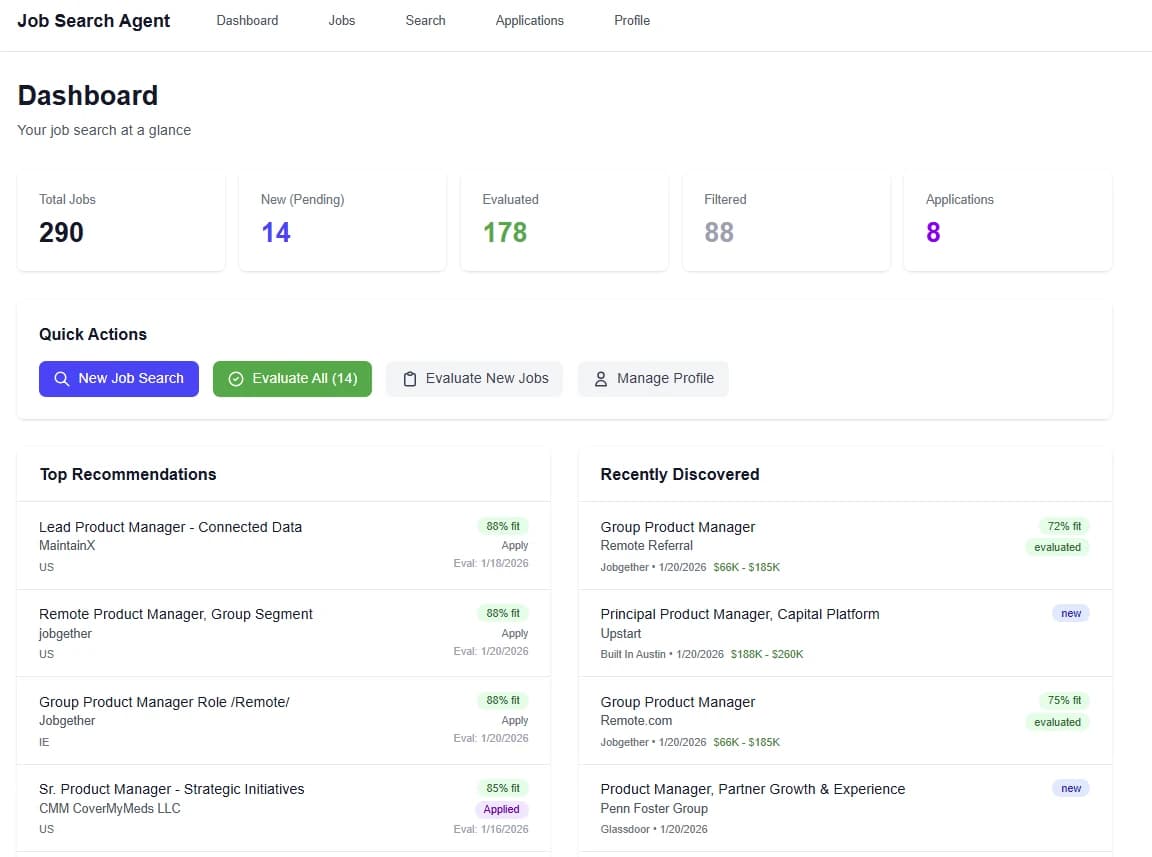
Dashboard — Track your job search pipeline at a glance: jobs discovered, evaluated, filtered by deal breakers, and applications submitted.
I built JobSearchAgent because I needed it. Searching for my next full-time role meant drowning in job boards, manually reviewing hundreds of listings, and spending way too much time writing cover letters that were personable, role-specific, and actually sounded like me. I wanted something that could quickly tell me which roles I had a real shot at—and help me position my experience in a clear, strategic way.
JobSearchAgent uses a three-phase qualification framework that goes beyond keyword matching. It pulls the most important qualifications from each job posting, maps them back to evidence from my work history, and builds a structured case for why I'm a strong fit. It also aggregates listings from places like LinkedIn, Indeed, and ZipRecruiter, then filters them automatically using deal breakers I define in plain English. I put a lot of focus into the cover letter system because that's the part that usually slows me down the most. I needed the output to feel authentic, emphasize my real strengths, and still sound like me. The result is a "Think then Write" workflow that reasons through positioning first, then writes with tone controls so the voice stays consistent.
Now I can find high-probability matches faster, and I can actually see the evidence behind why each role fits. Once I'm confident it's worth applying, I can move from finding the role to submitting a complete application—including a strategic cover letter in my voice—two to three times faster than before, without it feeling generic or forced.
About & Philosophy
About
I've always loved building things. In my personal life, that's meant building furniture, renovating bathrooms, and tackling projects around the house. In my professional life, it's meant building product organizations, data platforms, and AI-powered tools from scratch.
I spent 8 years at HealthTrust (an HCA Healthcare subsidiary) where I went from the company's first Product Owner to founding their first Product Management organization—leading a $30M digital transformation across a $50B healthcare contract portfolio. Then 4+ years at EY managing product strategy for enterprise tax platforms serving 125K+ annual filings. The common thread? I kept finding myself drawn to the 0-to-1 work—building something where nothing existed before.
Throughout my career, I'd tell my wife (half-joking) that I wished I were a developer so I could get ideas out of my head and into customers' hands faster. Now, with AI, I can. That's why I started consulting independently—helping small and medium-sized businesses adopt AI through hands-on delivery of production-ready tools, automations, and custom apps.
Philosophy
The builder's mindset is probably why Agile clicked for me so quickly. The core idea is simple: ship something real, learn from it, iterate. Before Agile, I spent too much time trying to plan my way into certainty. Now I know that I get further, faster, by putting a rough prototype in front of real people and letting reality do the teaching.
That same principle applies to how I work with AI. The tools are incredible—but they don't replace the fundamentals. You still need to understand the problem, talk to users, think critically about solutions, and iterate relentlessly. AI just lets you compress cycles from weeks to hours. Speed without judgment is just chaos. Speed with judgment? That's leverage.
Let's Connect
Interested in discussing product strategy, AI innovation, or potential collaboration? I would love to hear from you.